PUT THE PHONE DOWN?
ARE MOBILES MAKING RIDING LESS SAFE?
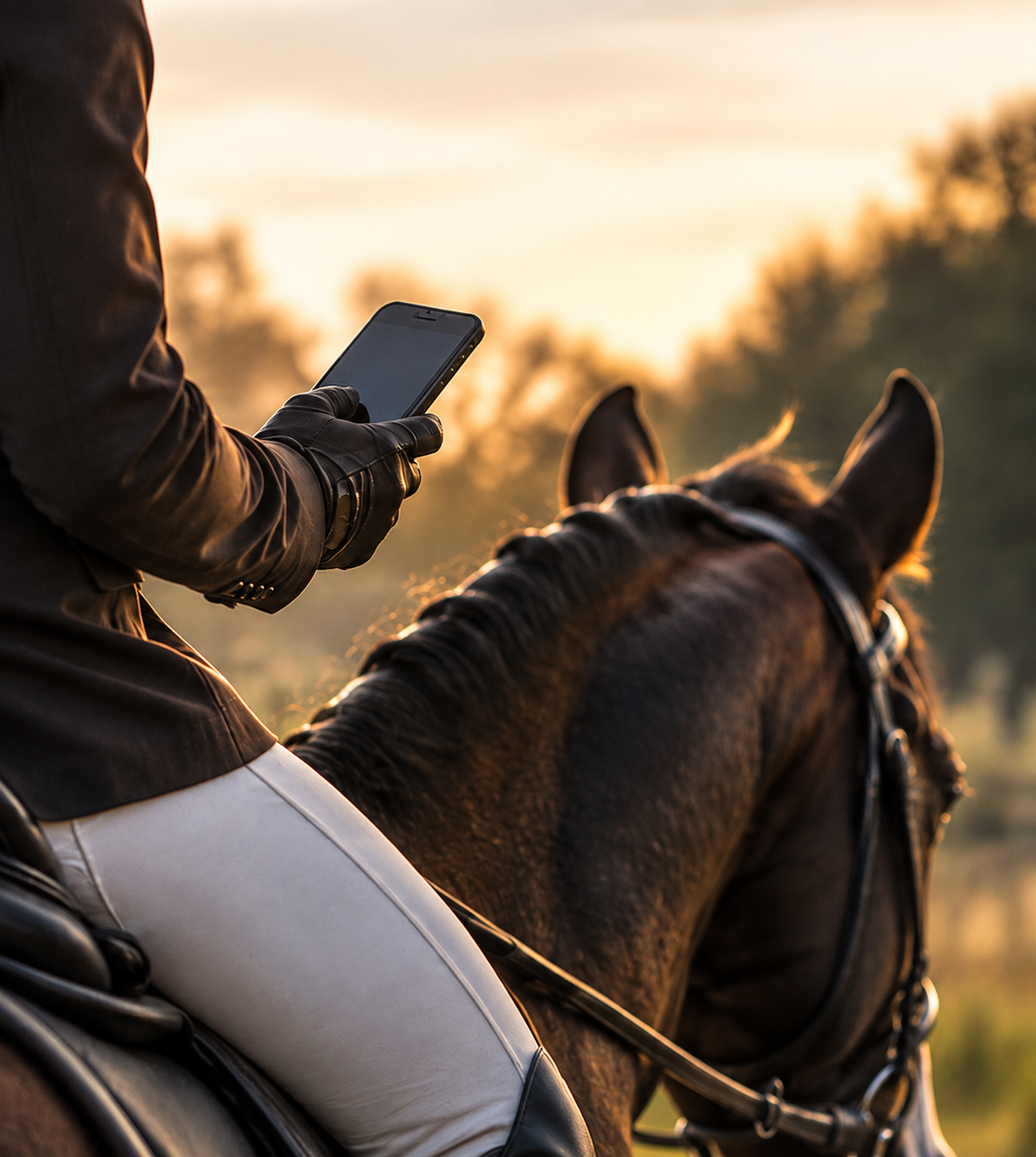
Mobile phones are part of everyday life. But should they be part of riding horses?
A rider hacking down the road with a phone in their hand.
Someone sitting on a horse outside an arena, scrolling through a screen.
A work rider looking down at a message while the horse underneath them gradually wanders from one side of the string to the other.
Most of us have probably seen it.
And increasingly, nobody seems particularly surprised by it.
So when did using a mobile phone while riding become normal?
WHEN YOUR ATTENTION IS SOMEWHERE ELSE
Horses demand attention.
Even the quietest horse is still an animal capable of reacting to something we haven't noticed. A vehicle approaching. A dog appearing from a gateway. A plastic bag moving. Another horse changing direction.
Or, because they're horses, apparently absolutely nothing at all.
Yet seeing someone looking down at a screen while their horse continues moving isn't particularly unusual anymore.
They look up. Realise they've wandered sideways. Put the phone down. Carry on.
Most of the time, absolutely nothing happens.
But does the fact that we get away with something most of the time necessarily make it safe?
We already recognise distraction as a serious issue elsewhere. Using a hand-held phone while driving is illegal in the UK in most circumstances.
Of course, a horse isn't a car.
A horse has a mind of its own.
Which raises an interesting question:
Does that make paying attention less important - or more?
WHEN DID WE STOP REACTING TO IT?
Perhaps that's the more interesting part of this conversation.
There was a time when being unreachable for an hour wasn't particularly remarkable.
Now our phones contain almost everything.
Messages. Work. Maps. Music. Cameras. Social media. Emails. Emergency contacts.
We're accustomed to being connected almost constantly.
And perhaps the horse world never actually decided that using a phone while riding was acceptable.
Perhaps society simply changed around it.
Something that might once have earned a fairly quick "Put that away while you're riding" can now pass without anybody saying anything.
And the more often we see something, the less unusual it becomes.
So have we reached a point where phone use on horseback has simply become part of the scenery?
And if so, does normal automatically mean acceptable?
THE PHONE ISN'T NECESSARILY THE PROBLEM
There is, of course, another side to this.
Taking a mobile phone riding can be an extremely sensible thing to do.
The British Horse Society recommends carrying a charged mobile phone when riding out. In an emergency, being able to call for help and communicate your location could be incredibly important.
But the BHS also draws a distinction between carrying a phone and using one. Its road-riding guidance says it isn't safe to use a mobile phone while riding on roads and that it should be used only in an emergency.
And that distinction matters.
Perhaps the question isn't whether phones belong around horses at all.
It's when carrying one for safety becomes being distracted by one.
Checking a map because you're lost isn't necessarily the same as scrolling through social media.
Calling the yard because there's been an accident isn't the same as replying to messages.
Stopping somewhere safe to use your phone isn't necessarily the same as looking down at it while your horse is still moving.
So where exactly is the line?
AND WHAT ABOUT WHEN RIDING IS YOUR JOB?
The question becomes even more complicated in a professional environment.
If you're being paid to ride or handle somebody else's horses, should different expectations apply?
Published racing-industry health and safety guidance has included sample mobile-phone policies restricting phone use while riding, leading or handling horses except in an emergency.
So the idea that mobile-phone distraction around horses can be a workplace safety concern isn't new.
But having guidance written down and changing everyday behaviour aren't necessarily the same thing.
Which leads to perhaps the bigger question.
WHO IS ACTUALLY RESPONSIBLE?
If a rider is regularly distracted by their phone while mounted, whose job is it to say something?
The rider themselves?
A parent?
Their instructor?
A coach?
A trainer or employer?
A competition organiser?
Or should another rider be able to say "Put the phone away and pay attention" without immediately being accused of interfering or targeting somebody?
Because if everybody can see something happening, but everybody assumes it's somebody else's responsibility to deal with it, nothing changes.
And if nobody challenges a behaviour for long enough, eventually it simply becomes normal.
IF IT'S A SAFETY ISSUE, SHOULD THERE BE CONSEQUENCES?
This is where the conversation gets more difficult.
If existing safety advice isn't enough to change behaviour, what happens next?
Should professional yards enforce their own phone policies more strictly?
Should riding schools and coaches have clear rules during lessons?
Should competition organisers restrict phone use in collecting rings or warm-up areas?
Should equestrian governing bodies introduce stronger rules?
And if rules exist, should there actually be consequences for breaking them?
A warning?
Being asked to leave an arena?
A sporting penalty?
A fine?
Or would that be taking regulation far too far for something riders should be perfectly capable of managing themselves?
There is also a major difference between guidance, workplace policy, sporting rules and the law.
An employer can set rules for employees. A sporting body can regulate competitors within its jurisdiction. Creating legislation that applies to riders more broadly is another matter entirely.
So even if we decide stronger rules are needed, another question immediately follows:
Who should make them - and where should they apply?
BECAUSE THE RISK ISN'T NECESSARILY YOURS ALONE
There's another reason this isn't purely about personal choice.
A rider looking at their phone who misses the moment their horse reacts may fall off.
Now there's potentially a loose horse.
That could be on a road.
In a warm-up arena.
On the gallops.
On a bridleway.
Or among other horses and riders.
That doesn't mean looking at a phone inevitably causes an accident.
It doesn't.
But when something does go wrong around half a tonne of independently thinking animal, the consequences may affect people who had absolutely nothing to do with the original decision.
And that's where "It's my choice" becomes a more complicated argument.
Because when does your personal choice become somebody else's safety issue?
SO WHERE DO WE DRAW THE LINE?
Maybe phones have become so deeply embedded in everyday life that equestrian culture has simply changed with them.
Maybe most riders use them perfectly sensibly and introducing more rules would solve a problem that doesn't require regulating.
Or maybe we've become so accustomed to seeing phones in people's hands that we've stopped questioning behaviour we would once have considered unsafe.
So:
Should a phone stay in your pocket whenever your horse is moving?
Is using one while stationary different?
Should employers, coaches and parents be doing more?
Should equestrian governing bodies have clearer rules?
If rules already exist but aren't enforced, are they achieving anything?
Would actual penalties improve safety - or would that be completely disproportionate?
And perhaps the biggest question of all:
When did seeing someone on their phone while riding become so normal that most of us stopped reacting to it?
If distraction around horses really is a safety issue, perhaps it's time we decide whether the answer is education, enforcement, personal responsibility - or simply accepting that the way we ride has changed.
What do you think?
A quiet note when a new Behind the Finish Line article is published.

Leave a Reply