HAVE WE FORGOTTEN HOW TO KEEP IT SIMPLE?
Bits, bridles, nosebands, gadgets and endless choice - are we helping our horses, or have we made things more complicated than they need to be?
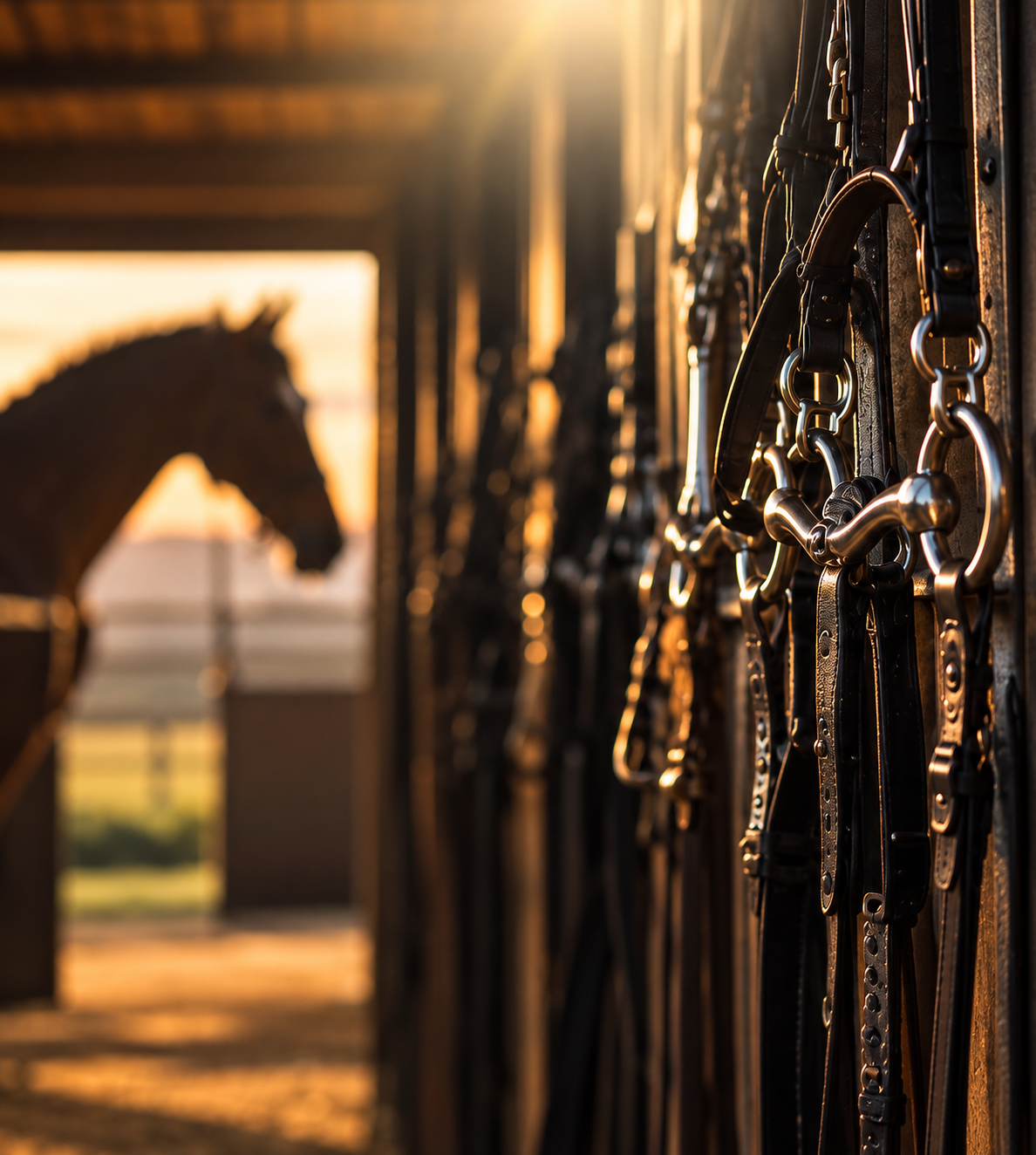
Walk around almost any equestrian competition and look at the tack.
Bits.
Nosebands.
Martingales.
Breastplates.
Hoods.
Boots.
Bandages.
Different mouthpieces, cheek pieces and rein attachments.
Sometimes several of them on the same horse.
And sooner or later, somebody will say it:
"Strip it all back. Keep it simple."
It's one of those phrases that's been around horses forever.
But is simple actually better?
Or do we now have more knowledge, more specialist equipment and more ability to find something that genuinely suits an individual horse than previous generations ever had?
Perhaps the problem isn't that we've got too many gadgets.
Perhaps it's whether we actually understand them.
WHY IS IT THERE?
Here's a simple question.
Look at everything your horse is wearing.
Could you explain why every piece of it is there?
Not:
"That's what everyone in my discipline uses."
Not:
"My instructor told me to put it on."
Not:
"The horse came with it."
Not:
"Everyone seems to have one at the moment."
But what does it actually do?
Where does it act?
Why does this horse need it?
And do you understand what happens when you use it?
Because there's an enormous difference between knowing how to put something on a horse and understanding what that piece of equipment does once it's there.
ARE WE SOLVING THE PROBLEM - OR CHANGING THE BEHAVIOUR?
A horse starts throwing its head.
Change the bit.
It opens its mouth.
Change the noseband.
It gets strong.
Add something else.
It becomes difficult to control.
Try another combination.
Sometimes changing equipment may be exactly the right answer. Different horses have different mouths, conformation, sensitivities and ways of going. Something that suits one horse may be completely wrong for another.
But perhaps there's a question we don't ask often enough:
Why did the behaviour start in the first place?
Could there be discomfort?
Could the tack fit poorly?
Could there be a dental issue?
Could the horse be confused?
Could it be a training problem?
Could the rider be contributing?
Or could the horse simply be telling us that something we're already using doesn't suit them?
That doesn't mean every buck is caused by a saddle or every head toss by a bit.
But it does raise an important distinction:
Changing the behaviour isn't necessarily the same as solving the problem.
BUT SIMPLE DOESN'T AUTOMATICALLY MEAN KINDER
The argument works both ways.
A plain snaffle isn't automatically kind simply because it looks simple.
A more complicated bit isn't automatically cruel because it looks intimidating.
The hands at the other end of the reins matter.
Fit matters.
Training matters.
The individual horse matters.
All bits create pressure somewhere, and even equipment considered mild can cause discomfort if it is badly fitted or used with rough hands.
So perhaps counting the amount of tack on a horse tells us very little on its own.
Taking everything off isn't automatically good horsemanship.
Adding something isn't automatically bad horsemanship.
Understanding why you're doing either of those things might be the important bit.
DO WE EVEN KNOW IF IT FITS?
Before worrying about what we should buy next, perhaps there's an even simpler question.
Does the equipment we've already got actually fit properly?
A bit can sit incorrectly.
A noseband can be too tight or positioned poorly.
A browband can pinch.
A bridle can create pressure in places we didn't intend.
A saddle can become unsuitable as a horse changes shape.
Even equipment that is perfectly appropriate in principle can cause problems if it isn't fitted correctly.
And this raises another question.
Do ordinary riders actually know what they're looking for?
Knowing which buckle goes where isn't necessarily the same as understanding whether the finished result is comfortable for the horse.
Sometimes we may be looking for an incredibly complicated solution when the problem is something surprisingly basic.
HOW MUCH ARE WE ACTUALLY TAUGHT?
Most of us learn the basics.
Here's a saddle.
Here's a bridle.
Here's how you tack up.
Here's how you clean it.
Here's how you adjust it.
And then somewhere between those early lessons and owning horses as adults, we're suddenly confronted with an enormous world of bits, mouthpieces, nosebands, bridles and training aids.
There is education available.
Equestrian organisations, qualified fitters and specialist professionals publish guidance and offer education on tack, bridle and bit fitting.
So perhaps the problem isn't that the information doesn't exist.
It's this:
Does the average horse owner know where to find it?
And, perhaps more importantly:
How do they know whose information to trust?
BECAUSE EVERYBODY HAS AN OPINION
For many riders, knowledge is picked up gradually.
Your instructor recommends something.
Someone experienced on the yard suggests something else.
A friend swears by a particular bit.
A fitter has another suggestion.
You watch a video.
You read an article.
You ask in a Facebook group.
You follow a professional rider.
Then somebody on TikTok tells you everything you've just been told is wrong.
Suddenly we're not short of information at all.
We're drowning in it.
One person says something is harsh.
Another says their horse has never been happier in it.
One says strip everything back.
Another recommends specialist equipment.
One trainer suggests one approach.
Another trainer says the opposite.
So who does the ordinary rider listen to?
Perhaps we've confused having more information with having more knowledge.
ARE WE CHOOSING EQUIPMENT - OR FOLLOWING FASHION?
Because equestrian equipment has trends just like everything else.
Certain brands become fashionable.
Certain bridles suddenly appear everywhere.
A particular bit becomes popular within a discipline.
A successful rider uses something.
People notice.
Social media accelerates all of it.
And there's nothing inherently wrong with that.
Sometimes products become popular because they're genuinely good.
But there's a difference between buying the same saddle pad as your favourite rider and putting a piece of equipment on your horse because your favourite rider uses it.
One is fashion.
The other physically interacts with an animal.
So when something becomes popular, are we asking:
"Would this suit my horse?"
Or:
"Everyone seems to be using these now."
And how often do those two thoughts get confused?
TRADITION CAN DO EXACTLY THE SAME THING
It isn't only social media.
Different disciplines develop their own traditions.
Certain pieces of equipment simply become what you expect to see.
A young rider can grow up surrounded by a particular setup without ever consciously choosing it.
It's just what horses doing that job wear.
There may be perfectly sound reasons for those traditions.
But shouldn't we still understand them?
"That's what everyone uses" isn't quite the same answer as "this is why my horse needs it."
THEN THERE'S THE RULEBOOK
And riders don't always have complete freedom to choose.
Competition governing bodies decide which equipment is permitted, restricted or prohibited within their sports.
Different disciplines maintain their own tack and equipment rules, and those rules can change.
There are obvious reasons for equipment rules.
Welfare. Safety. Fairness. Consistency.
But they create another interesting question.
What happens when the equipment your individual horse genuinely seems happiest in isn't permitted in the competition you want to enter?
Perhaps the horse has gone comfortably in it for years.
Perhaps you've worked with an experienced professional to find it.
Then the rules change - or you enter a discipline where that equipment isn't allowed.
Who should have the final say?
The rider who knows the horse?
The specialist advising them?
Or the governing body responsible for setting welfare and competition standards for thousands of horses?
DO WE NEED MORE RULES - OR BETTER EDUCATION?
There's an argument for stronger regulation.
If particular equipment presents an unacceptable welfare risk, perhaps governing bodies should restrict it.
There's also an argument for regulating fit and use rather than simply banning particular designs.
And there's an argument that riders should ultimately be trusted to make appropriate decisions for their own horses.
Perhaps the answer involves all three.
But if equipment is prohibited or restricted in the name of horse welfare, perhaps riders also need to understand why.
Because a rule can stop somebody using something.
Education might stop them wanting to use it incorrectly in the first place.
AND SOMEWHERE AMONGST ALL OF THIS IS THE HORSE
This is perhaps the easiest part to lose.
We've got trainers.
Coaches.
Professional riders.
Bit fitters.
Bridle fitters.
Saddle fitters.
Governing bodies.
Manufacturers.
Tradition.
Social media.
Friends.
Facebook groups.
And approximately four thousand people in the comments who are absolutely certain they know the answer.
But there's one opinion we're ultimately trying to interpret.
The horse's.
Perhaps we've actually become much better at listening.
Horse welfare is discussed more openly. We have specialist fitters. We understand more about pressure and comfort. Governing bodies are changing rules. Riders have access to information previous generations could never have found so easily.
That's progress.
But greater knowledge has arrived alongside greater choice, greater marketing and an almost endless stream of opinions.
And perhaps that's why the simplest question is still the most useful:
What is this horse actually telling us?
Not what TikTok says.
Not what somebody in the collecting ring says.
Not what's fashionable.
Not even necessarily what worked brilliantly on your last horse.
This horse.
SO... HAVE WE FORGOTTEN HOW TO KEEP IT SIMPLE?
Maybe.
Perhaps sometimes we're too quick to add another piece of equipment before investigating what's underneath the problem.
But "strip everything off" can be just as simplistic.
Perhaps having more options has actually improved welfare because we can tailor equipment much more closely to individual horses.
Perhaps the problem isn't too many gadgets at all.
Perhaps it's whether we have enough understanding of the gadgets we've got.
So let's ask:
Could you explain why every piece of equipment on your horse is there?
Do you know whether it's fitted correctly?
Should education about bits, bridles and training aids be easier for ordinary riders to access?
Where should riders go for genuinely reliable information - and how do we know who to trust?
Are we influenced too heavily by fashion, social media and what successful riders use?
Are some pieces of equipment there simply because our discipline has always used them?
Should governing bodies regulate equipment more closely - or give riders more freedom to choose what suits the individual horse?
When a horse develops a problem, are we sometimes too quick to change the equipment before asking what caused the problem?
And finally:
Have we got too many gadgets - or have we simply forgotten that knowing how to use them matters more than how many we've got?
Perhaps good horsemanship isn't about using more.
And perhaps it isn't about using less.
Perhaps it's about understanding why you're using it - and listening to the horse underneath it.
What do you think?
A quiet note when a new Behind the Finish Line article is published.

Leave a Reply